GEO Tools Pricing & Unit Economics Guide
Most GEO and AEO tools hide real costs behind tight prompt caps and engine add-ons. Here is how to compare cost per 100 prompts and tracking accuracy.
On this page (4 sections)
A $29/month starting price on a GEO tool landing page almost never matches what you pay once you track a real set of buyer questions.
Across the 24 AI visibility platforms in our directory, entry plans typically cover just 15 to 40 prompts across two or three models. The moment you monitor 100 commercial prompts across ChatGPT Search, Perplexity, Google AI Overviews, and Claude, most monthly bills jump to $158–$295/month.
1. Advertised Price vs. Real Cost per 100 Prompts
Headline pricing in the GEO category is designed to lower signup friction, not reflect steady-state monitoring. A $29 starter plan with 15 prompts looks cheap until you multiply it out to a real B2B keyword cluster.
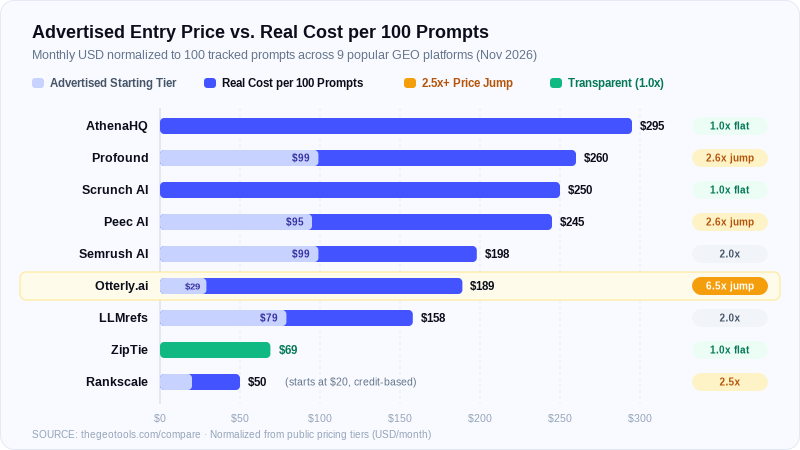
Look closely at the spread between entry price and 100-prompt scale:
| Platform | Entry Plan | Entry Prompts | Real Cost / 100 Prompts | Tracking Method | Refresh Cadence |
|---|---|---|---|---|---|
| Rankscale | $20/mo | 40 | $50/mo | Hybrid (credits) | On-demand |
| ZipTie | $69/mo | 100 | $69/mo | Web UI capture | Weekly |
| LLMrefs | $79/mo | 50 | $158/mo | Web UI capture | Daily |
| Otterly.ai | $29/mo | 15 | $189/mo | Hybrid | Weekly |
| Semrush AI | $99/mo | 50 | $198/mo | Web UI capture | Daily |
| Peec AI | $95/mo | 25 | $245/mo | Web UI capture | Daily |
| Scrunch AI | $250/mo | 100 | $250/mo | Web UI capture | Daily |
| Profound | $99/mo | 50 (1 engine) | $260/mo | Web UI capture | Daily |
| AthenaHQ | $295/mo | 100 | $295/mo | Hybrid | Daily |
Three pricing patterns explain almost every surprise bill SEO teams complain about on X and agency Slack channels:
- Prompt caps shrink fast under multi-engine multipliers. Some vendors sell "credits" or "AI responses" instead of prompts. Tracking 100 prompts daily across 4 engines burns 12,000 responses a month — emptying a small credit pool in week one.
- Engine add-ons double the sticker price. Profound advertises a $99 starter tier, for example, but it covers a single engine; multi-engine teams land on the $399/month annual tier. Otterly.ai starts at $29 for 15 prompts, then jumps 6.5x to $189 when you move up to 100 prompts.
- Daily vs. weekly cadence changes both cost and signal. Weekly snapshots (ZipTie, Otterly.ai) keep costs low for steady content reporting. Daily tracking (Peec AI, LLMrefs, Profound) costs more because headless browser proxies run 7x as often.
2. Why Two GEO Tools Disagree: Web UI vs. Raw API
One of the loudest debates among SEO practitioners right now is why two paid trackers can run the exact same prompt on the same morning and report completely different winners.
The answer usually sits in the data collection pipeline. Across the 24 platforms we track, 14 use live Web UI capture (58%), 7 run a hybrid mix (29%), and 3 rely on raw API simulation (13%).
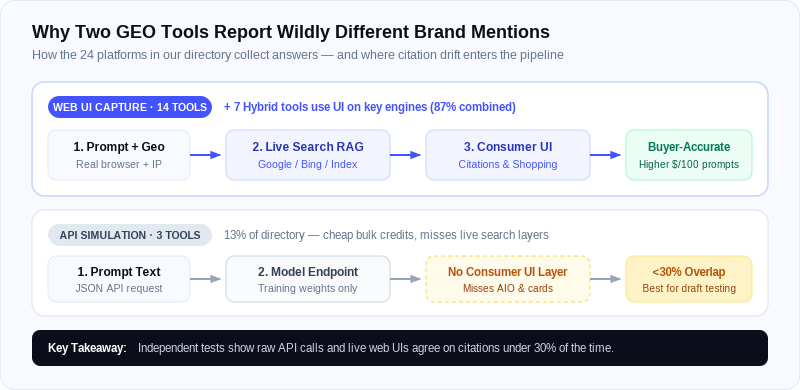
When a real buyer types "best CRM for 20-person agencies" into ChatGPT or Google, the consumer product does far more than sample a base LLM:
- Live search retrieval (RAG) fires real-time web queries against Google or Bing indices and injects fresh snippets into the prompt context.
- Geo-location and UI modules alter local recommendations, inline citations, and ChatGPT Shopping product cards.
- Post-processing filters rewrite or ground citations before rendering the final answer.
Independent testing shared across the SEO community shows that raw developer API responses and live consumer UI outputs often share under 30% citation overlap. Raw API trackers are cheap and fast for testing brand positioning in bulk, which makes them handy for rough directional checks — but if you report Share of Voice to clients or a CMO, you want Web UI capture or a transparent hybrid stack.
3. The "AI Rank #1" Trap (and What to Track Instead)
Traditional Google SEO trained an entire generation of marketers to obsess over single-number positions: We moved from #5 to #2 this week.
Large language models do not work like deterministic blue-link rankings. Run the exact same non-branded prompt in ChatGPT ten times in a row, and the brand order shifts almost every time.
That insight separates useful GEO workflows from noisy vanity dashboards:
- Stop tracking single-run positions. Look for tools that measure visibility rate (% of runs mentioning your brand) or Share of Voice across a prompt cluster over 7 to 30 days.
- Avoid the "Infinite Prompt Fallacy." Many teams dump 500 generic top-of-funnel prompts into a tracker on day one, blow their budget, and drown in noise. Start with 25 to 50 bottom-of-funnel prompts where buyers actually compare vendors (
best X for Y,X vs Y,alternatives to Z). - Ignore single-day sentiment swings. One weird hallucination in a Tuesday crawl is statistical noise, not a PR crisis. React only when a pattern holds across multiple crawls and multiple engines.
4. One Last Sanity Check Before You Buy
Before paying any vendor $200+ a month to boost your AI search visibility, check how they treat their own website.
Every week, we run an automated 12-signal live check across all 24 vendor domains for AI crawler rules, XML sitemaps, /llms.txt and /llms-full.txt spec quality, valid multi-entity JSON-LD, SSR text density, and speed. The average vendor scores 74/100, and only 3 of 24 (13%) break 90/100 on their own site.
You can inspect every vendor's live score on our GEO Self-Audit Leaderboard, compare Otterly.ai vs. Peec AI or Peec AI vs. Profound side by side, or run the exact same technical check on your own site with our free GEO site checker.
Put this data to work
Compare all 24 GEO platforms or audit your own domain
Sort every platform by real cost per 100 prompts, Web UI vs. API tracking, and weekly GEO self-audit scores — or check your own site's /llms.txt and AI bot rules for free.
More Research & Field Guides
All guides →Best AEO & GEO Tools Tested (2026)
We compared 24 AEO and GEO tools by real 100-prompt pricing, Web UI tracking, and honest trade-offs so you can pick the right stack without overpaying.
We Audited 24 GEO Vendors on llms.txt
We ran a live audit across 24 GEO tool domains for llms.txt, AI bot rules, and JSON-LD — plus what Google and Jeremy Howard actually say about it.