Perplexity Rank Trackers Tested (2026)
How Perplexity picks citations (only 30–40% exact Google Top-10 overlap), which trackers capture real Perplexity footnotes, and how to allow PerplexityBot.
On this page (4 sections)
Ranking #1 on Google does not guarantee a citation in Perplexity — and ranking #18 on Google does not disqualify you either.
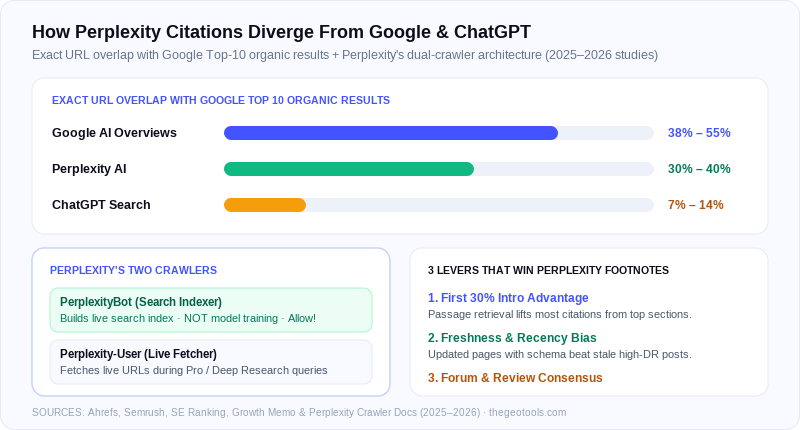
Across 2025–2026 empirical studies from Ahrefs, Semrush, and SE Ranking, only 30% to 40% of exact URLs cited by Perplexity appear in Google's Top 10 (compared with 38%–55% for Google AI Overviews and just 7%–14% for ChatGPT Search). Because Perplexity runs its own live search index and passage-level reranker, tracking Google rankings alone leaves you completely blind to a channel whose referral visitors convert at roughly 10.5% vs. 1.76% for organic search (Seer Interactive GA4 benchmark).
1. Why Perplexity Citations Diverge From Google Rankings
If you have ever pasted a high-intent query into Perplexity and wondered why a 14-month-old niche site got footnote [1] ahead of a DR 90 incumbent, three retrieval mechanics explain it:
- Passage-level scoring & the "First 30% Intro Advantage": Meta-analyses from Growth Memo and Zyppy found that the vast majority of LLM citations are pulled from the top 30% of a page. Perplexity scores atomic answer blocks individually — a tight 40-word verdict table near the top beats a 3,000-word essay that buries the answer in paragraph nine.
- Stronger freshness bias: Unlike base LLMs stuck on monthly training cutoffs, Perplexity weights publication and
dateModifiedrecency heavily on fast-moving software, pricing, and news queries. Fresh, cleanly structured pages often earn footnotes within hours ofPerplexityBotcrawling them. - Forum & third-party consensus: Ahrefs Brand Radar data consistently shows Reddit, review platforms, and independent comparison directories capturing a huge share of Perplexity citations because the engine actively seeks diverse viewpoints rather than repeating a vendor's own marketing copy.
2. Best Perplexity Rank Trackers Compared (From Our 24-Tool Database)
Not every tool that lists "Perplexity" on its feature page measures it the same way. Some capture live web UI footnotes daily; others run cheap API approximations or weekly snapshots. Here is how the strongest Perplexity trackers in our directory compare on real data:
| Platform | Perplexity Method | Refresh Cadence | Est. / 100 Prompts | Tool Score | Best Use Case |
|---|---|---|---|---|---|
| Searchable | Web UI capture | Daily | $165/mo | 92/100 | Daily Perplexity + ChatGPT citation share |
| Profound | Web UI capture | Daily | $260+/mo | 89/100 | Enterprise multi-engine + crawler telemetry |
| Scrunch AI | Web UI capture | Daily | $250/mo | 89/100 | Pairing Perplexity citations with PerplexityBot server logs |
| Peec AI | Web UI capture | Daily | $245/mo | 82/100 | Cleanest competitor Share of Voice for agencies |
| LLMrefs | Web UI capture | Daily | $158/mo | 82/100 | Affordable daily UI footnote tracking |
| ZipTie | Web UI capture | Weekly | $69/mo | 74/100 | Lowest flat-rate UI capture for SMBs |
| Otterly.ai | Hybrid UI + API | Weekly | $189/mo | 72/100 | URL-level citation mapping + unlimited seats |
| Rankscale | Hybrid credits | On-demand | $50/mo | 72/100 | Budget on-demand checks for solo founders |
3. PerplexityBot vs. Perplexity-User: The robots.txt Mistake That Kills Citations
One of the most common technical mistakes we find on SaaS sites is a blanket "block all AI" rule copied from a 2023 blog post.
Perplexity operates two distinct crawlers:
- `PerplexityBot` (Live Search Indexer): Crawls and indexes pages strictly for Perplexity's real-time answer search — not for training foundational models. It honors
robots.txt. If you blockPerplexityBot, your pages drop out of substantive Perplexity citations immediately. - `Perplexity-User` (User-Triggered Live Fetcher): Fetches live URLs on demand when a Pro or Deep Research user explicitly queries a topic or URL. Following Cloudflare's 2025–2026 stealth-crawling audits and publisher pushback, tightening explicit
robots.txtpolicies has become the clean standard.
Use this clean robots.txt snippet to welcome live Perplexity citations while keeping full control over private routes:
# Allow Perplexity live search indexing & user-triggered citations
User-agent: PerplexityBot
Allow: /
Disallow: /admin
Disallow: /api/

User-agent: Perplexity-User
Allow: /
Disallow: /admin
Disallow: /api/
4. A 10-Minute Perplexity Citation Readiness Checklist
Before paying for a Perplexity rank tracker, verify these four fundamentals on your highest-value comparison and pricing pages:
- Test live `PerplexityBot` access and SSR HTML: Run your domain on our free 12-signal GEO site checker — it verifies
PerplexityBotrules, XML sitemap HTTP 200 status, valid JSON-LD, raw server-rendered word count, and TTFB speed in 3 seconds. - Front-load a 2-sentence verdict + comparison table in the first 30% of the page: Give Perplexity's passage extractor clean, quotable facts without forcing it to parse marketing fluff.
- Keep visible `Updated` dates and `dateModified` JSON-LD accurate: Real updates to pricing tables or benchmarks trigger fast recency gains in Perplexity footnotes.
- Publish a clean `/llms.txt` for research agents: Build one in under a minute with our free llms.txt generator, then compare ZipTie vs. Otterly.ai or Peec AI vs. Profound once you are ready to monitor citations at scale.
Put this data to work
Compare all 24 GEO platforms or audit your own domain
Sort every platform by real cost per 100 prompts, Web UI vs. API tracking, and weekly GEO self-audit scores — or check your own site's /llms.txt and AI bot rules for free.
More Research & Field Guides
All guides →Best AI Visibility Tools Tested (2026)
We scored 24 AI visibility tools on tracking accuracy, real 100-prompt cost, and site audits — plus why AI referrals convert 4x higher than organic search.
Best AEO & GEO Tools Tested (2026)
We compared 24 AEO and GEO tools by real 100-prompt pricing, Web UI tracking, and honest trade-offs so you can pick the right stack without overpaying.
We Audited 24 GEO Vendors on llms.txt
We ran a live audit across 24 GEO tool domains for llms.txt, AI bot rules, and JSON-LD — plus what Google and Jeremy Howard actually say about it.