What Is GEO? Princeton Data & 2026 Guide
What Generative Engine Optimization (GEO) is using Princeton KDD 2024 data (arXiv:2311.09735), why keyword stuffing fails, and the Two-Layer GEO Stack.
On this page (12 sections)
- 1. How Generative Engines Measure Visibility (SEO vs. GEO)
- 2. Exact Princeton GEO-Bench Data: All 9 Methods Ranked
- 3. The Underdog Advantage: Why Rank-5 Sites Gain +115%
- 4. The Two-Layer GEO Execution Stack (2026)
- Layer 1: Technical Crawlability & Machine Access
- Layer 2: Evidence-Rich Content (Princeton GEO Factors)
- 5. Measuring Progress: From Paper Metrics to 2026 Commercial Tools
- Frequently Asked Questions
- What is Generative Engine Optimization (GEO)?
- Which GEO content strategies showed the highest lift in the Princeton study?
- Can lower-ranked websites outperform #1 incumbents in AI search?
- Primary Research References
Generative Engine Optimization (GEO) is the discipline of structuring technical site signals and verifiable content evidence so AI-powered answer engines — such as ChatGPT Search, Perplexity, Google AI Overviews, and Claude — retrieve, synthesize, and cite your brand inside generated responses.
Unlike traditional SEO, where success is a single ordinal blue-link position (#1, #2, #3), generative engines synthesize multi-source paragraphs and weave inline citations across the answer. That shift changes both how visibility is measured and which edits actually move the needle.
The term and its first rigorous benchmark were introduced by researchers from Princeton University, Georgia Tech, IIT Delhi, and the Allen Institute for AI in *GEO: Generative Engine Optimization* (KDD 2024 / arXiv:2311.09735) — hosted officially at generative-engines.com/GEO. Instead of recycling vague marketing advice, this guide breaks down their exact GEO-Bench (10,000 queries) data and translates it into a practical 2026 operating stack.
1. How Generative Engines Measure Visibility (SEO vs. GEO)
In classic Google Search, ranking #1 captures a predictable slice of clicks and #5 captures far fewer. In a Retrieval-Augmented Generation (RAG) engine, five retrieved web pages are fed into an LLM context window at once, and the model decides how much space — and how prominent a position — each source earns in the final answer.
The Princeton authors formalized two visibility metrics that modern AI visibility tools now approximate as Citation Share of Voice and Brand Sentiment:
- Position-Adjusted Word Count (PAWC): Measures what share of the AI answer's words cite your page, weighted exponentially toward sentences appearing near the top of the response. Being cited in paragraph one with 45 words beats a passing footnote in paragraph five.
- Subjective Impression: Evaluates seven qualitative dimensions — relevance, influence on the answer, uniqueness of insight, diversity, follow-up likelihood, position, and citation count — capturing whether the model frames your brand as an authority or an afterthought.
| Dimension | Traditional SEO | Generative Engine Optimization (GEO) |
|---|---|---|
| Primary Unit of Competition | Ranked URL position (#1–#10) | Citation share & prominence inside synthesized answers |
| Core Retrieval Gate | Googlebot crawl, index & backlinks | Live RAG fetch (OAI-SearchBot, PerplexityBot, SSR HTML) |
| Winning Content Signal | Keyword relevance & topical depth | Verifiable statistics, attributed quotes, primary source citations |
| Keyword Stuffing Impact | Neutral to mildly risky | -8.3% visibility drop on GEO-Bench (-9.1% on live Perplexity) |
| Challenger Site Dynamics | Hard to overtake high-DR #1 incumbents | Rank-5 pages gained up to +115.1% citation share with citations |
2. Exact Princeton GEO-Bench Data: All 9 Methods Ranked
The researchers evaluated nine distinct content transformations across GEO-Bench (10,000 queries spanning MS MARCO, ORCAS-1, Natural Questions, Perplexity.ai Discover, ELI-5, and domain-tagged verticals) and validated top tactics on live Perplexity.ai.
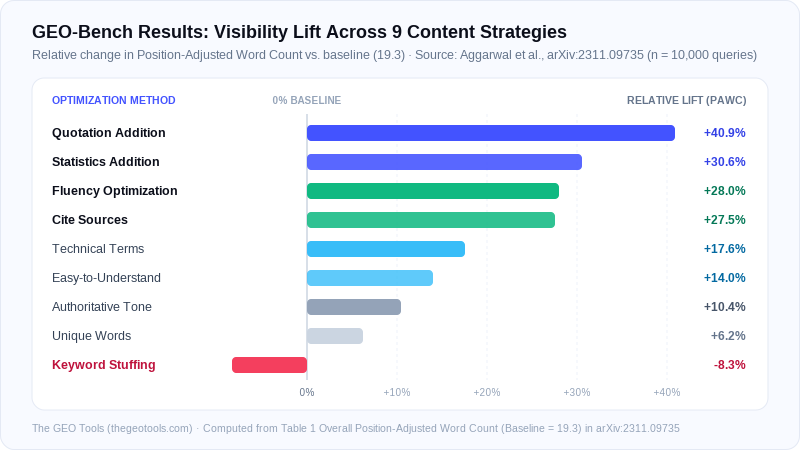
Here are the exact Position-Adjusted Word Count scores from Table 1 of arXiv:2311.09735 (baseline without optimization = 19.3):
| Strategy | Overall PAWC | Lift vs. Baseline | What It Actually Means in Practice |
|---|---|---|---|
| Quotation Addition | 27.2 | +40.9% | Add attributed expert quotes, founder remarks, or primary user statements |
| Statistics Addition | 25.2 | +30.6% | Replace vague adjectives ("fast", "affordable") with exact numbers & benchmarks |
| Fluency Optimization | 24.7 | +28.0% | Tighten sentence structure, cut filler, improve scannable flow |
| Cite Sources | 24.6 | +27.5% | Link out to credible studies, official docs, standards, or primary datasets |
| Technical Terms | 22.7 | +17.6% | Use accurate domain terminology instead of watered-down generalities |
| Easy-to-Understand | 22.0 | +14.0% | Clarify complex mechanisms with plain-language explanations and examples |
| Authoritative Tone | 21.3 | +10.4% | Write decisive, evidence-backed recommendations rather than hedged fluff |
| Unique Words | 20.5 | +6.2% | Modest lexical variety helps slightly, but cannot substitute for facts |
| Keyword Stuffing | 17.7 | -8.3% | Repeating target keywords unnaturally causes LLMs to skip or down-weight chunks |
On live Perplexity.ai (Table 4 of the paper), the same pattern held cleanly: Quotation Addition lifted Position-Adjusted Word Count by +20.7% (and Subjective Impression by +30.0%), Statistics Addition boosted Subjective Impression by +37.2%, while Keyword Stuffing again dropped Position-Adjusted Word Count by -9.1%.
3. The Underdog Advantage: Why Rank-5 Sites Gain +115%
Perhaps the single most encouraging result in arXiv:2311.09735 (Table 2) is who benefits most.
When a page already sits at traditional Google Rank #1, aggressive rewrites produced smaller or even slightly negative shifts — because the page already dominated baseline context. By contrast, pages sitting at Rank #4 or Rank #5 (the exact territory where independent SaaS products, startups, and challenger blogs compete against giant incumbents) captured massive gains:
- Cite Sources at Rank #5: +115.1% relative visibility gain
- Quotation Addition at Rank #5: +99.7% relative visibility gain
- Statistics Addition at Rank #5: +97.9% relative visibility gain
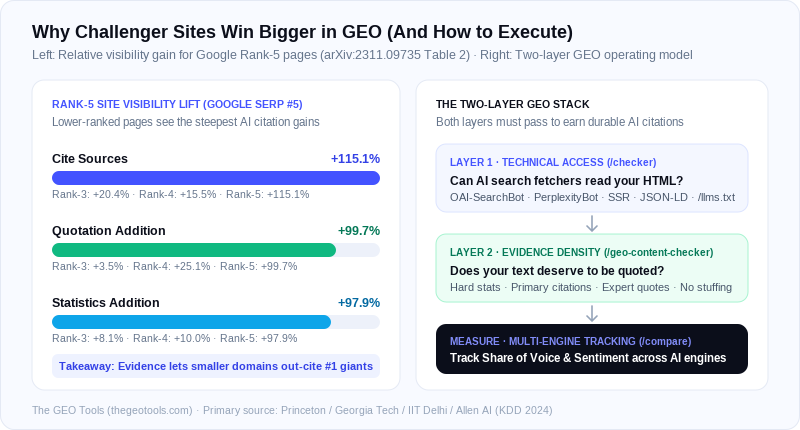
Why does this happen? Because RAG engines typically retrieve the top 5–10 search candidates and then re-rank facts per chunk, not Domain Rating alone. If the #1 enterprise page is 2,000 words of generic marketing copy while your #5 page contains a clean comparison table, verified pricing math, primary citations, and direct practitioner quotes, the LLM pulls your passage into the answer.
4. The Two-Layer GEO Execution Stack (2026)
Most GEO guides confuse two completely separate layers. You need both working together:
Layer 1: Technical Crawlability & Machine Access
Before an AI model can weigh your statistics or quotes, its fetcher must actually retrieve your content cleanly. Across our 24-vendor live GEO leaderboard, several well-funded SaaS sites still accidentally fail basic technical checks:
- Allow search fetchers in `robots.txt`: Keep
OAI-SearchBot,PerplexityBot, andClaudeBotunblocked even if you choose to restrict training-only crawlers. - Render key facts in server HTML (SSR): Lightweight RAG fetchers rarely run full JavaScript hydration — pricing tables, specs, and JSON-LD must exist in the raw HTTP response.
- Ship valid multi-entity JSON-LD & clean Markdown docs: Include accurate
Organization,SoftwareApplication,FAQPage, orArticleschema, and publish a clean `/llms.txt` index for AI research and coding agents.
Test Layer 1 on your own domain right now with our Free 12-Signal GEO & llms.txt Site Checker (or generate a spec-ready index in 60 seconds via our Free `/llms.txt` Generator).
Layer 2: Evidence-Rich Content (Princeton GEO Factors)
Once your HTML is crawlable, audit the citation worthiness of your highest-intent landing pages, pricing guides, and blog posts against the exact signals validated in GEO-Bench:
- Quantitative density: Aim for concrete numbers (prices, sample sizes, percentages, latency, dates) every 120–180 words instead of unsupported adjectives.
- Primary source citations: Link out to original studies, official documentation, arXiv papers, or public changelogs rather than circular blog posts.
- Attributed direct quotes: Include short, specific quotes from domain practitioners, documentation, or real customer feedback.
- Chunk-friendly fluency: Open every H2 section with a crisp 2-sentence answer, keep paragraphs under ~75 words, and use Markdown tables for structured comparisons.
- Zero keyword stuffing: Keep target phrases natural (under ~2.5% density) and use accurate domain terminology instead of repeating exact-match keywords.
5. Measuring Progress: From Paper Metrics to 2026 Commercial Tools
Once both layers are live on your core pages, you need a way to track whether ChatGPT, Perplexity, and Google AI Overviews actually start citing your domain more often:
- Starting under $100/month? Compare ZipTie ($69/100 prompts, Web UI capture), OpenSEO (free tier + MCP-first workflows), and Rankscale ($20/mo starter credits) in our 2026 GEO Tools Pricing Guide.
- Reporting weekly Share of Voice & Sentiment? Look at daily Web UI trackers like Searchable, Peec AI, or LLMrefs — they map directly to the paper's Position-Adjusted Word Count and Subjective Impression concepts.
- Need full side-by-side filtering? Explore all 24 tracked platforms in our live GEO tools comparison matrix or read our Perplexity rank tracker deep dive.
Frequently Asked Questions
What is Generative Engine Optimization (GEO)?
Generative Engine Optimization (GEO) is the practice of structuring technical crawlability and verifiable content evidence (statistics, source citations, direct quotes, and scannable fluency) so AI answer engines like ChatGPT, Perplexity, and Google AI Overviews retrieve and cite your pages.
Which GEO content strategies showed the highest lift in the Princeton study?
Across 10,000 GEO-Bench queries in arXiv:2311.09735, Quotation Addition (+40.9%), Statistics Addition (+30.6%), Fluency Optimization (+28.0%), and Cite Sources (+27.5%) achieved the highest relative gains in Position-Adjusted Word Count, while Keyword Stuffing dropped visibility by -8.3%.
Can lower-ranked websites outperform #1 incumbents in AI search?
Yes. Table 2 of the Princeton GEO study showed that pages ranked 5th in traditional search gained up to +115.1% AI citation visibility when adding source citations, +99.7% with quotations, and +97.9% with concrete statistics.
Primary Research References
- Aggarwal, P., Murahari, V., Rajpurohit, T., Kalyan, A., Narasimhan, K., & Deshpande, A. (2024). GEO: Generative Engine Optimization. KDD 2024. arXiv:2311.09735 · Official project site: generative-engines.com/GEO
- Open-source benchmark dataset: GEO-Bench on HuggingFace (10,000 multi-domain queries) and reference code repository GEO-optim/GEO on GitHub.
Put this data to work
Compare all 24 GEO platforms or audit your own domain
Sort every platform by real cost per 100 prompts, Web UI vs. API tracking, and weekly GEO self-audit scores — or check your own site's /llms.txt and AI bot rules for free.
More Research & Field Guides
All guides →Best AEO & GEO Tools Tested (2026)
We compared 24 AEO and GEO tools by real 100-prompt pricing, Web UI tracking, and honest trade-offs so you can pick the right stack without overpaying.
Best AI Visibility Tools Tested (2026)
We scored 24 AI visibility tools on tracking accuracy, real 100-prompt cost, and site audits — plus why AI referrals convert 4x higher than organic search.
Perplexity Rank Trackers Tested (2026)
How Perplexity picks citations (only 30–40% exact Google Top-10 overlap), which trackers capture real Perplexity footnotes, and how to allow PerplexityBot.